
How To

Partial Application

Warning, novice functional thinker here. If you know your stuff, what follows may cause distress.

I was messing with F# last night and I got a gentle reminder that I’m still a long way from thinking functionally, it still takes a lot of effort.

I started with this

let evens r = List.filter (fun x -> x % 2 = 0) r
> evens [0..10];;

val it : int list = [0; 2; 4; 6; 8; 10]

Simple enough. Even numbers are multiples of 2. Rekindling childhood memories of typing code from books by Tim Hartnell into a ZX81, I did what I would have done then. I tried to make the code do something slightly more complicated. What about a function that can find multiples of any number, not just 2.

Continue reading

The Anagrams Kata

The following is my C# implementation of the Anagrams Kata as described on cyber-dojo.com

Write a program to generate all potential anagrams of an input string.

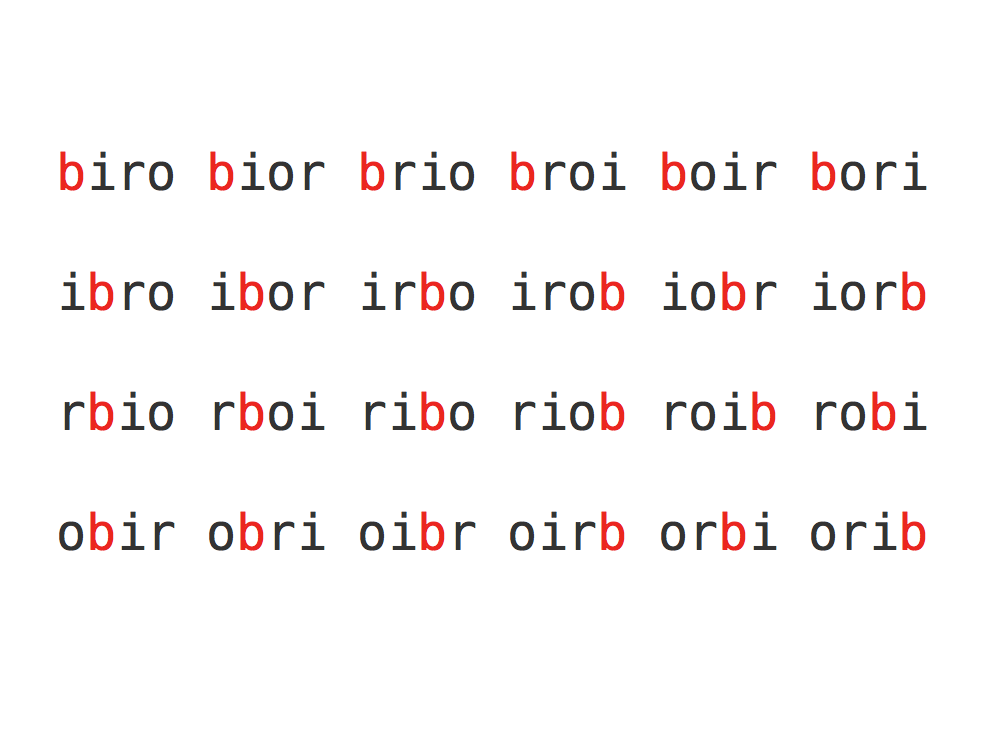
For example, the potential anagrams of “biro” are

biro bior brio broi boir bori
ibro ibor irbo irob iobr iorb
rbio rboi ribo riob roib robi
obir obri oibr oirb orbi orib

Let’s write a test.

[Test]
public void NoCharacters()
{
    var expected = new List<string> {""};
    Assert.That(Anagrams.Of(""), Is.EqualTo(expected));
}

As is almost always the case, we start with the degenerate case of an empty string. We don’t do this solely to ensure the degenerate case is handled (that’s part of it), but with this first test we’re thinking about the API of our new code.

Continue reading

Getting Functional with F# and The Game Of Life

One session at NDC that really kicked my grasp of functional programming up a few notches was Vagif Abilov’s discussion of Conway’s Game Of Life using F#.

I’m not going to rehash the rules of Game Of Life here, if you aren’t familiar with them then read this.

Vagif’s source code is on github and his slides are on slideshare. His stuff is well worth a look, but don’t look yet.

If you want to really play along with the spirit of this post, stop reading now, and go and code up Conway’s game of life in the object oriented language of your choice. I’ll be here when you get back.

Continue reading

Fluent Mocking

Here’s a scenario (for once not a hypothetical scenario, this is a real system I worked on). I was building a wizard based app. To be more accurate I was building lots of wizard based apps.

After a couple of wizards the functionality became clear and I extracted it to it’s own framework. My apps could then focus on actual bread and butter functionality.

Two of the objects in my framework are ‘Wizard’ and ‘WizardStep’. A Wizard contains WizardSteps. You get the idea.

Continue reading

← Newer 3 / 3